
N.B. The original version of this essay was published for atu2.com.
Have you ever been listening to a familiar song and suddenly noticed something new about it? This happens to me all the time, especially with U2’s music. If I hear something new or particularly interesting, my music theory training instinctively kicks in and compels me to dive deeper. That’s what this series, “Theoretically Speaking…”, is all about: an exploration of music through the lens of music theory.
You may be thinking, “What is ‘music theory’?” It’s a discipline within the field of music that approaches the subject from technical perspectives in an attempt to understand how music “works.” Rhythm, meter, pitch, contour, form, harmony, and voice-leading are just a few of the elements music theorists explore. Therefore, this series examines music by engaging primarily with various aspects of the music itself. From there, I derive different interpretations or connections to extra-musical elements like lyrics, religion, or even history, thereby deepening my understanding of the music.
Before I begin, here’s a little background about me. I have a Ph.D. in music theory; my dissertation analyzes the formal and stylistic characteristics of U2’s signature sound. I teach music theory at the college level, where my students learn how to read and write music proficiently as well as how to analyze music of different genres from both written and aural standpoints. Popular music is my research specialty. I focus specifically on form (how songs are constructed), the perception and indentification of song structure, and the interpretative connection between lyrics and music.
I remember being awestruck when U2 performed “Zooropa” from inside the expanded video screen on the 360 tour in 2011, but it was watching the Paris concerts from the Innocence + Experience tour in November and December 2015 that renewed my interest in the song. The use of “Zooropa” as a transition from “Bullet The Blue Sky” to “Where The Streets Have No Name” was a masterstroke. Thematically, “Zooropa” works both on its own as well as a bridge between “Bullet” and “Streets” (more on that below). But as I re-watched this segment of the concert, I kept wondering if there was more than just a thematic link. Are there musical reasons “Zooropa” works so well at such a critical juncture in the show?
To my nerdy delight, I discovered that there are indeed musical reasons it’s a perfect fit. My analysis of “Zooropa,” which is restricted to the portion of the song after Bono’s vocal line enters (~1:52 onward), is divided into two sections. The first is my interpretation of the lyrics, which serves as the foundation for the second section. Using just a bit of music theory, I illustrate how the rhythmic content of Bono’s vocals reflects the theme of uncertainty and how this theme is tied not only to contemporary social and political issues, but also to the band’s attitude toward their own career in the early 1990’s.
A Guiding Light: The Lyrics of “Zooropa”
The lyrics of the song can be divided into two sections: those that come before the guitar break at 3:44 and those that come after. For the purposes of this analysis, I’ll refer to the former as “Part 1” and the latter as “Part 2.” Part 1 lyrics are characterized primarily by lines beginning with the word “Zooropa” followed by an advertising slogan from a variety of products ranging from cars (Audi: “Vorsprung durch Technik”) to diet drinks (SlimFast: “Eat to get slimmer”) to airline travel (United Airlines: “Fly the friendly skies”). The lyrics of Part 2 trade the commercial slogans for more personal sentiments. “Uncertainty” is the main theme of this section, evinced from the start with the lyrics “And I have no compass and I have no map.” After declaring he’s lost his way, the narrator admits to having no motivation to return to the place from which he came: “And I have no reasons… to get back.”
This (self-)doubt does not last, however. The narrator hears “ridiculous voices,” at least one of which (perhaps The Fly or MacPhisto) is trying to convince the narrator that he (the narrator) already possesses the wherewithal to make it through challenging times: “You’ve got the right shoes to get you through the night.” Toward the end of the song, the voice goes even further by trying to persuade the narrator that not having a map or a religion may actually be a good thing: “Uncertainty can be a guiding light.”
The importance of this particular lyric can be linked directly to U2’s history and is the lynchpin to understanding my alternative interpretation of the lyrics. According to Bono, “Zooropa” is about the social and political climates in Europe at the end of the 1980’s. When examined from a different perspective, however, the song can be interpreted as a personal reflection of the state of U2’s career in the early 1990’s. Achtung Baby signaled enormous aesthetic and sonic shifts for the band. For many die-hard fans, the darker tone and increased electronic manipulation took some getting used to. Even the band itself struggled with the change in direction, as shown in the excellent documentary From The Sky Down. The band’s efforts paid off, though; Achtung Baby was a rousing critical and popular success. As important as the 1991 album was, however, its eventual follow-up was just as important. U2’s approach to 1993’s Zooropa would go a long way in determining Achtung Baby’s place in the band’s catalog.
In retrospect, had Zooropa sounded like late-1980s U2, Achtung Baby might seem like a one-off experiment, more of a side project than a direction change. But Achtung’s success proved that this creative shift was more than a passing fancy. The Joshua Tree’s accolades and commercial success — the “compass” and “map” to sustained superstardom — were all but forgotten with the overwhelmingly positive reception of Achtung Baby. Zooropa, therefore, expanded upon the electronic foundation provided by its predecessor, in a way legitimizing such a profound artistic change.
From an outsider’s perspective, this decision might have seemed like a no-brainer, but the lyrics to Zooropa’s eponymous opening track reveal the band’s initial hesitation to slide further down the proverbial (electronic) rabbit hole. The difference between the narrator’s attitude and that of the voices in the “slipstream” indicates U2’s early reluctance to continue in the direction Achtung Baby pointed, perhaps because of the difficulties the band faced making their 1991 masterpiece.
But U2 is a shrewd group and eventually decided to continue with the new aesthetic. The lyrics at the conclusion of “Zooropa” reflect the band’s shift from uncertainty to promise. The “dream out loud” line indicates the acknowledgement and acceptance that 1) 1990s U2 necessarily has to be radically different from the U2 of the previous decade, and 2) this is a good thing. They embraced the uncertainty and wrote songs chronicling this journey through uncharted territory.
The Appliance of Science: Rhythmic Depictions of Uncertainty
In its broadest sense, syncopation is defined as putting an accent in a place where an accent is not placed normally. As a nonmusical example of syncopation, say the word “watermelon.” The accent is usually placed on the first syllable: WAtermelon. Now, instead of stressing the first syllable, try stressing the second: waTERmelon. Weird, right? This is the essence of syncopation: accenting the normally unaccented. Syncopation is one of the defining characteristics of rock music. A basic rock beat features prominent snare drum hits on the second and fourth beats of a 4/4 measure, traditionally the two weakest beats in that meter.
Bono certainly is not the only singer-songwriter to incorporate syncopation in his vocal lines. However, the syncopated rhythm in “Zooropa” is more than just a stylistic byproduct. It is a rhythmic representation of the theme of uncertainty portrayed in the lyrics. One of the most significant examples of syncopation occurs on arguably the most important line of the entire song:

Here, the rhythm perfectly encapsulates the meaning of the lyrics. Starting “late” on the second half of the first beat creates a highly syncopated rhythm that clouds the straightforward “4/4-ness” of the meter. The syncopated nature of the rhythm becomes even more pronounced when compared with a recomposed version (below), in which the line starts “on time” on the downbeat. Though the original rhythm is preserved, eliminating much of the syncopation drastically changes the character of the line. Beginning on the downbeat creates a rhythm that is less intricate than the original, one that is less directly tied to the lyrics than the original rhythm, and one that is therefore (in my opinion) much less interesting.

A detailed analysis of the entire vocal line yields more interesting results. One rhythmic pattern is particularly noteworthy. The rhythm used with the first two words of the line “Be a winner” is unique within Part 1:
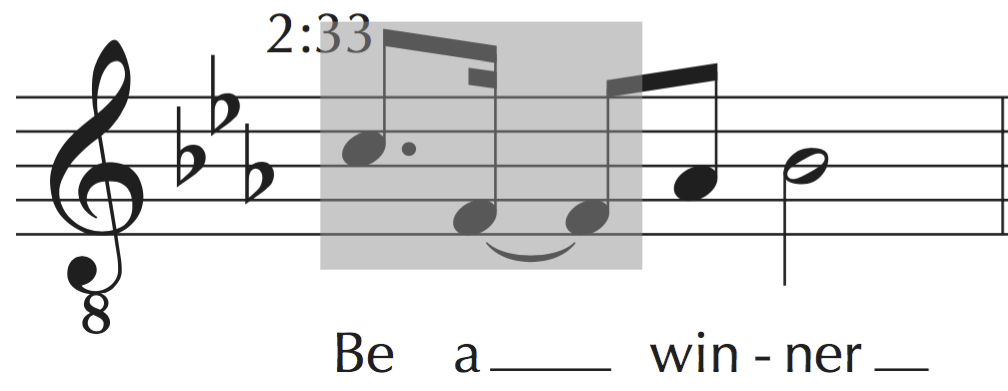
While it is not the first or only instance of syncopation in Part 1, it is the only example of syncopation that uses this specific rhythm in this half of the song. Given its exclusivity, it may seem at first that this rhythm is just an anomaly, maybe even a mistake. An analysis of the rest of the vocals, however, reveals that this is not at all the case. Rather, this “anomaly” foreshadows several important moments in Part 2. That particular rhythm — the equivalent of two dotted eighth notes — returns more than two minutes later, reappearing in the lines “And I don’t know the limit, the limit of what we got” and “You’ve got the right shoes”:


Several measures later, three consecutive lyrical phrases begin with the same rhythm as an anacrusis (upbeat):

This exact rhythm is used six times in Part 2 and could be classified as the defining rhythmic pattern of the song.
In addition to the rhythm itself being central to the song’s meaning, so too is its duration. There are several ways to notate the length of one and a half beats in a 4/4 meter, three of which are used in “Zooropa” as anacruses a total of 11 times throughout Part 2. Below are examples of each variation:

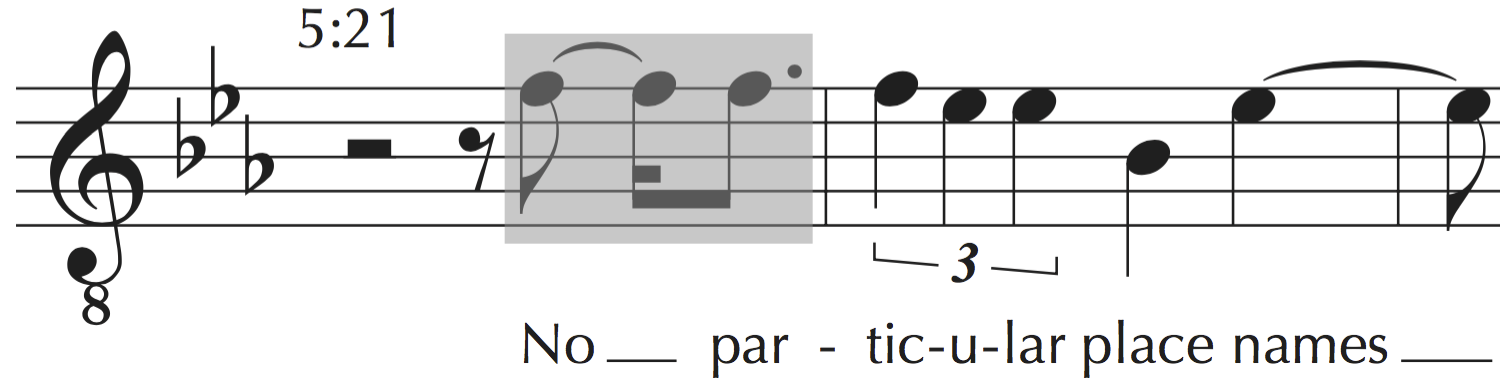

At the 3:44 mark, a guitar break ends Part 1 and, with the help of what sounds like the sonic equivalent of an oscilloscope, transitions into Part 2. Initially, this oscillation may seem innocuous, but a closer analysis reveals that the duration of the interlude is also connected to the rhythms discussed above. The five-measure rest in the example below represents the four-measure guitar solo and a one-measure fade out, in which the oscillator enters. Curiously, what follows is an incomplete measure of 4/4. After those five measures, only one and a half beats — the equivalent of three eighth notes — elapse before Part 2 begins in earnest at 3:58. This single “rogue” measure of 3/8 disrupts the regularity of the song’s overall 4/4 meter. At this point, the listener may be as uncertain of the meter as U2 were about themselves and the Zooropa album. But the 3/8 meter lasts a scant one measure before 4/4 is restored and Part 2 commences.

Better By Design: What It All Means
Analyzing the lyrics and rhythm of “Zooropa” has shed new light on why it works so well as a bridge between “Bullet” and “Streets” in the context of the Innocence + Experience show. Texturally and sonically, the minimally arranged snippet of “Zooropa” functions as a soothing comedown from the intensity of “Bullet” while also providing a smooth segue into the famous organ and guitar intro of “Streets.” “Zooropa” works on a thematic level, too. The song itself progresses from a commentary about consumerism to self-reflection to a message of hope and possibility. This parallels the thematic progression from “Bullet” (pointed commentary) to “Zooropa” (self-reflection) to “Streets” (hope, potential). Although only a snippet of “Zooropa” was used in the concert, the song’s theme of uncertainty is referenced by the accompanying visuals of wandering refugees. Their past has been left behind, their present is being destroyed, and their future is anything but certain. In true U2 style, the music addresses an important social crisis while maintaining the thematic flow of the concert.
The question my students ask me most often is, “Do composers know all that stuff is in their music?” My response is, “Maybe, maybe not.” But it doesn’t matter if they do or not. Was Shakespeare conscious of the various meanings and layers in his plays and sonnets? Maybe, maybe not. But again, that’s not the point. What does matter is that those nuances have been discovered. They’re in there, whether The Bard was aware of it or not. U2 may or may not be aware of the rhythmic connections to the theme of uncertainty, but that doesn’t matter. As I’ve demonstrated, they’re in there just waiting to be discovered.
Lineup:
BETH SILVA
CHRISTINE RUSSELL
HOLLIE BLANKENSHIP
MONICA HUMPHREY
NETTIE PECK
BRIANNA WILLIS
ELISE PRATT
VERONICA ENGLAND
MASON DECKER
 Christopher Endrinal