Tag Archives: Bono

Keep Calm…

… And try not to lose your shit over the potential partnership between two of your favorite things: Apple and U2.

Or so I’m telling myself in the wee hours of the night before 1) I teach three classes, and 2) a big iPhone announcement that maybe-possibly-hopefully-prettypleasewithsugarontopI’lldoalmostanythingtomaketheserumorstrue involves U2. Much to my surprise, however, many U2 fans don’t share my enthusiasm. Here’s why this collaboration is good for both parties:

For Apple, it’s a product announcement involving the company’s cash cow: the iPhone. This event would get media coverage even if U2 wasn’t involved. But more than that, teaming up with U2 brings some added pizzazz to what promises to be an already big day for the tech goliath. Of late, Apple keynotes, while still the gold standard for tech announcements, have been a bit dry, due in no small part to the absence of Steve Jobs’ charisma and presence in front of an audience. Samsung (grr) paired up with Jay-Z last year. How much the hip hop mogul actually boosted sales numbers is irrelevant; what’s important is that it the event lent a bit of “cred” to Samsung’s image and created additional buzz for its newest flagship phone. No offense to Jay-Z, but U2 is in a whole other league when it comes to global visibility and marketability. Regardless of what anyone says about relevancy, the relatively “disappointing” sales figures of 2009’s No Line On The Horizon, or a lack of an album in more than five years, U2 is still the biggest band on the planet. I can tell you from firsthand experience that Apple doesn’t like to be outdone. Getting U2 involved with the new iPhone (and potentially the Beats music service) outdoes anyone, anywhere, for years to come.

For U2, it gets the band back into the public consciousness immediately. It’s an instant marketing campaign that will help promote the new album and (eventually) the accompanying tour. I can recall going to the an early 360 show and seeing the Blackberry ads all over the stadium and being sorely disappointed in that joint venture. Besides the signs at concerts and logos on merchandise, what did BlackBerry (then called RIM) do to help the band generate buzz? Nothing. In 2009, RIM was already on the verge of technological irrelevance, to say nothing of its social cache. A partnership with Apple would also assuage the second Bono’s two fears: U2 not making good music and not being culturally relevant. The first should have been allayed earlier this year when “Ordinary Love” was nominated for Oscar and “Invisible” launched on Super Bowl Sunday (which I think, despite lukewarm critical and chart success, is a great song; I wrote about the song for @U2). Not only is Apple technological relevant, but the company also occupies a front-and-center public profile thanks in large part to the ubiquity of iPhones and iPods.

Additionally, teaming with Apple shows that the band has (once again) embraced the latest trends in digital media. In the early 1990’s, that was the whole ethos behind the groundbreaking Zoo TV tour, albeit with an ironic twist. A decade ago, U2 and Apple worked together when the latter was the undisputed king of mobile digital music. Before the iPhone, the iPod was Apple’s moneymaker, and U2 was in on it. There were several iPod commercials and products featuring the band: silhouette campaign (here’s the extended version),  video iPod, and the special edition U2 iPod. Still need further proof that the Apple/U2 relationship is deep? Open up the Music app on in iOS and look at the “Artists” option at the bottom of the screen. Look familiar? Even through all the software updates and upgrades, it’s been Bono’s silhouette for years.

Bono:iTunes

 As for the issue of how the band will be involved tomorrow… well that’s a whole other discussion. In a nutshell, here’s what I envision for the partnership:

U2 is this announcement’s “one last thing.” Tim Cook announces a collaboration with U2 that includes a redemption code for the iTunes store. This code allows the new iPhone owner to download the band’s newest album (whenever that drops; I think October) that will feature digital content like music videos, interviews, and live performances. This would help boost sales figures, which would make both the band and the record company happy. Accompanying the new record be a new official U2 app that will be linked to a newly redesigned website that focuses on fan interaction. Behind the scenes footage, exclusive interviews and photos, unreleased tracks, digital wallpapers, along with a one-year subscription to the fan club, which will offer more goodies. The announcement ends with U2 playing a short set.

I’m trying not to get ahead of myself here, but the sheer excitement is making me thing crazy things. This is all “pie in the sky” speculation, of course, but it’s going on six years since the band’s last full-length studio record, so I think U2 fans will can be forgiven for getting a little giddy. All this conjecture does set us up for some massive disappointment, but such is the life of a die-hard fan.

This arrangement is a good thing, folks. It has the potential to be a game-changer. Odds are it won’t be the earth-shattering event my imagination has vividly outlined, but with these two global icons in cahoots, it’s not out of the realm of possibility. Both Apple and U2 have been game-changers for their respective fields. Who’s to say it can’t happen again tomorrow?

NLOTH, 2 years later

U2’s latest studio album, No Line On The Horizon, came out two years ago this week, and it was just over two years ago that I posted my initial reaction to the album.  With that in mind, I thought I’d write another entry regarding that record, how I think it’s stood up over two years and its place in the U2 catalogue.

First thing’s first: NLOTH is a slow burner.  That is, it takes a little while to “get it.”  It’s a much more lyrically and musically conceptual album than the other two albums from this style period, How To Dismantle An Atomic Bomb (2004) and All That You Can’t Leave Behind (2000), which is good and not-so-good.

Nope: The so-so stuff first.  NLOTH doesn’t sound like any previous U2 album in terms of overall feel.  It’s got the signature U2 elements, to be sure, such as The Edge’s echo, Larry’s signature drums, and Adam’s pulsating bass.  Perhaps the disjointed feel has to do with the order of tracks.  I’m OK with “No Line On The Horizon” starting the record and “Cedars of Lebanon” finishing it, but I think several tracks in between are out of place.  “FEZ-Being Born” doesn’t feel quite right as track #8.  It’s a two part song, with the first half a slow, quiet cacophony of street sounds, some organ lines, and an echo of the “Let me in the sound” line that is first heard in “Get On Your Boots,” and the second part is a more energetic run towards its end.  I think “FEZ” would have made a great opening track, especially considering its two-part construction and the conceptual nature of the album as a whole.  It would have made the perfect introductory track.  As track #8, however, “FEZ” feels more like a non-sequitur that comes out of nowhere, especially following two rockers like “Boots” and the Led Zeppelin-esque “Stand Up Comedy.”  Here’s a revised track listing that I think would have helped the album’s flow:

  1. FEZ-Being Born
  2. Get On Your Boots
  3. Magnificent
  4. Breathe
  5. Moment of Surrender
  6. White As Snow
  7. Unknown Caller
  8. Stand Up Comedy
  9. I’ll Go Crazy If I Don’t Go Crazy Tonight
  10. No Line On The Horizon
  11. Cedars of Lebanon

With this track order, there are two distinct halves to the record, with the “O Come Emmanuel”-based “White As Snow” functioning as the dividing line.  This track order would give the record two distinct peaks (“Breathe” and “No Line”), and both halves would end with slow songs (“Moment of Surrender” and “Cedars”).  Radical, I know, but I think the order works to give the listener more of a literary exposition-conflict-climax-denoument impression than the scattered original order.

Yup: With all that being said, I think the record is a solid one overall.  The good tracks are really, really good.  Originally, I thought “Magnificent” would the next great U2 song, following in the footsteps of “Pride,” “Where the Streets Have No Name,” and “Beautiful Day,” to name but a few.  But as I lived with the album, it wasn’t “Magnificent” that took the mantle, rather it was “Breathe.”  A song of hope (“Every day I / have to find the courage to / walk out into the street / with arms out / got a love you can’t defeat”) and defiance (“Neither down nor out / there’s nothing you have that I need / I can breathe”) and courage (“The roar that lies / on the other side of silence / the forest fire: / that is fear, so deny it”), “Breathe” is a rocker that I can easily play on repeat and not get tired of it.

“Magnificent,” while not holding up quite as well as I thought it would, is still a great song.  You want the trademark U2 sound?  “Magnificent” has it all: long, dramatic introduction; Adam’s rich, powerful, active bass line; The Edge’s signature echo; Larry’s driving drumbeat; Bono’s soaring lyrics about love; dynamic use of the stereo field; a wide open, spacious sound.  This is, perhaps, the most easily accessible song on the record.  That is, it would appeal U2 newbies (U2bies?) as well as longtime U2 die-hards.

The lead single, “Get On Your Boots,” got a lot of criticism, for reasons I can’t understand.  Listen to the song carefully: It’s “Vertigo Part II,” and I think that’s a good thing.  The texture, form, lyrical content (“Let me in the sound” is a perfect introduction to the artistic direction of this record) are all very similar to “Vertigo,” and that song rocked the house.

Hidden Gem: “Unknown Caller.”  This song is amazing, but it’s not for the uninitiated.  Like the record as a whole, this one took a little bit to grow on me, but after a while, and especially after seeing it live on the 360 Tour, I’m adding this one to the “Must Listen” list.  It’s a complex song, but the ambiguity reflected by the title is clearly represented in the music and lyrics.  What “accident” is Bono referring to?  Where is the protagonist?  We don’t know for sure, and I think that’s the whole message of the song.  It’s a conversation between the narrator and someone or something else (the devil?  his conscience?  an angel?) at some undisclosed, nondescript location.  He’s at a crossroads in his life and he’s searching for meaning.  This song could even be interpreted as a metaphor for the band themselves.  After such a long and distinguished career, U2 are at another crossroads.  Where do they go from here?  The uncertainty is never resolved: the song’s ending is harmonically open-ended, suggesting that there’s more out there for the protagonist (U2?).

Album Hero: Without a doubt, the hero of this album is Adam Clayton.  His bass lines on this record are simply amazing.  There is hardly a track on which Adam’s lines aren’t front and center.  His tone is big, thick, and rich, without being overpowering, providing the perfect foundation upon which The Edge and Bono can flourish.  Check out the chorus sections in “Breathe,” “Magnificent,” and “Unknown Caller.”  He give heft and gravity to the verses in “Get On Your Boots,” “Stand Up Comedy,” and “Cedars of Lebanon.”  30 years on, and Adam has never sounded better.

Must Listen: “Magnificent,” “Unknown Caller,” “Breathe,” “Stand Up Comedy.”

Overall impressions: This is a good album.  I wouldn’t go so far as to call it a great one, especially in light of some of U2’s other efforts.  But it’s a solid upper-midlevel record.  The way I see it, it’s definitely not for U2 newbies.  But for seasoned vets who know what to listen for, this one has got some good stuff.

U2: No Line On The Horizon

Amazon-iTunes_packshot2

U2’s new album, No Line On The Horizon, hits US stores this week.  There’s been a lot of press about the release, and rightfully so.  Even if you don’t like U2’s music, or Bono’s politics (which shouldn’t even enter the discussion when talking about an album, but alas some “reviewers” have trouble compartmentalizing), U2’s relevance in the pop/rock genre is undeniable.  They are one of the all-time greats, with the financial and critical success to back up such a claim.  This entry is a review of the album, as well as a review of some reviews I’ve read.  Dozens of music critics from around the globe have contributed their opinions on the band’s new work.  I’ve had the opportunity to live with the record for almost a week now, listening pretty much nonstop.  And while those critics may have more experience with pop/rock music in general, I feel certain that no one outside U2’s immediate circle has worked more closely with their music than I over the past two years.  So, here’s my not-so-humble opinion.

First, allow me to start by saying that a proper album review shouldn’t be made without living with the album for a little bit.  A few days at least, as initial impressions tend not tell the whole story.  Unfortunately, a couple of reviews reveal that the writers spent very little time with the album, and even less time with U2’s history or the band’s catalogue.  Time Magazine’s Josh Tyrangiel, a music critic for the periodical since 2001 (that’s right, Josh, I “Googled” your ass) writes a pretty scathing review of the band’s latest studio offering, going so far as to say it’s one of the band’s worst records.  I have a problem with that contention, seeing as the album hasn’t even been released yet (by the posting date of this entry).  It’s tough to put this album at either end of the spectrum (“greatest thing since sliced bread” or “worst thing since nuclear holocaust”) because it hasn’t yet had a chance to live.  Give it a year.  If it “only” sells 2 million copies, then consider it a dud.  The way I see it, however, sales numbers don’t tell half the story.  By U2 standards, 1997’s Pop was an abject failure, managing “only” to go double platinum here in the US.  Yet, after some time, critics and fans alike have recognized some of the brilliance on that album.  “Gone,” “Please,” “Do You Feel Loved,” and “Staring At The Sun” are prime examples.  But I digress.  

Another problem I have with Tyrangiel’s review is that his opinions on U2’s catalogue are, well, not quite right.  While he is correct in saying that the band’s last two records, All That You Can’t Leave Behind (2000) and How To Dismantle An Atomic Bomb (2004) saw Bono and the boys return to their stadium rock roots with “an ease of sound” and radio friendly hits like “Beautiful Day” and “Vertigo,” I’m still looking for the “lightness of theme” that Tyrangiel identifies.  I really don’t see what’s so light about singing about the death of a father (“Sometimes You Can’t Make It On Your Own,” “One Step Closer”), mortality (“In A Little While), unjust house arrest (“Walk On”), or the African AIDS epidemic (“Crumbs From Your Table”).  What made those albums work so well, Mr. Tyrangiel, is the fact that such heavy topics were broached in songs with such an easy flow to them that they didn’t feel as heavy as their subject matter.  Even going to back to U2’s early years, Tyrangiel “ranks” October (1981) higher that the band’s debut, Boy (1980).  What?  “I Will Follow,” “Twilight,” “Out of Control,” “The Electric Co.”…enough said.  And Zooropa (1993) being on par with Achtung Baby (1991) in terms of “gotta-have-it” status.  Again: What?  Sorry, but …no.

Back to NLOTH…

No Line On The Horizon was meant as a transitional album, away from the “standard” stadium rock sound of the band’s previous two records.  And that’s exactly what Bono declares in the lead single, “Get On Your Boots,” with the lyrics “Let me in the sound.”  It’s an experimental record that’s fusing “old” U2 with new sounds.  I’m confused as to why Tyrangiel has “trouble” with the song entitled “Magnificent” (in my estimation one of the next great U2 tracks and a blow-the-roof-off-the-concert-venue track).  Yes, it is a “catchy, thunderous love song.”  And?  Is that supposed to be bad?  Again, Josh, revisit your U2 history books: songs like that helped make them “The Biggest Band In The World” (TM).  How is Bono’s delivery an “ambivalent growl” that sounds “less like a love song and more like a grievance”?  A “growl” would suggest anger or frustration; however, there’s nothing growl-like his delivery.  In fact, his voice sounds damn good in this song, especially considering it’s high in the vocal range.  What, did you miss his passionate exclamations of “Magnificent!” in the song’s intro?  Sorry if a high A4 isn’t passionate enough for you, Josh.

The biggest problem I have Tyrangiel’s review is his blatant, unbashed cynicism.  Dude, lighten up and listen.  I mean really listen: there’s a lot of good stuff on this new record.  And remember your U2 history (oh wait, you don’t know much of it): critics like yourself foretold U2’s demise after Pop was released and failed to make waves.  But then along came “Beautiful Day” and ATYCLB.  After this band’s storied career, making it as far as they have from humble beginnings in Dublin with admittedly limited technical skills on their respective instruments, are you so quick to dismiss this album and write off a Rock ‘N Roll Hall Of Fame band?

Even more shocking to me than Mr. Tyrangiel’s review was Darryl Sterdan’s quip in the Toronto Sun about U2’s “fading relevance.”  In his review, he chronicles the various stages through which pop musicians’ careers go.  Interesting concept, I’ll give him that.  That’s about all I’ll give him.  He writes, “[NLOTH is] getting plenty of attention–but not the same sort of attention as their previous discs.”  Oh, really Darryl?  Is that why U2 are performing five night in a row on Letterman?  Is that why this release is being hyped as one of the biggest of the year and already put in contention for next year’s Grammy Awards?  He goes on to say that the lukewarm reception to “Get On Your Boots” and the subpar performance at this year’s Grammy’s doesn’t “bode well for Horizon‘s prospects with the public.”  Oh, really Darryl?  Much like Mr. Tyrangiel, I should remind you of a little U2 history.  Let’s go back to 1991 and the release of “The Fly” as the lead single from Achtung Baby.  I recall that single didn’t light up the charts, either, but the album went on to become, arguably, the band’s best.  And yet, later in the article, Sterdan files AB under the “Misstep & Stumble” category.  Excuse me?  An collection that almost wins Album of the Year (to take nothing away from Eric Clapton, AB arguably should have won) is a misstep and stumble?  I’m confused: if selling more than nine million albums while creating a new sound is a misstep and stumble, what the heck is Mr. Sterdan’s definition of success?  Ah, the bitter smell of cynicism wafting from the north.

Next, I must quote, to get the full effect:

“As any music geek can tell you, there are several stages in the life of an artist. And every act that hangs around long enough walks the same path: Aerosmith, AC/DC, Bowie, Dylan, KISS, R.E.M., Madonna, Springsteen, and countless others. Granted, not all of them go through the stages in the same order or at the same rate. Some skip stages. Others repeat them. A few get stuck in one for most of their careers. But eventually, most get to where U2 now find themselves.  Of course, the band that blazed the trail — like so many others — is none other than The Rolling Stones. Now that U2 is catching up, let’s follow the line that the British rock gods drew — and that leads inexorably to the Irish icons’ limited horizons.”

Whoa, Darryl.  Easy there, killer.  U2 catching up to the Stones in terms of irrelevance?  First of all, the Rolling Stones are NOT irrelevant.  Neither is Aerosmith (they have a video game!), AC/DC (just released a kick-ass record), Dylan (perhaps the greatest lyricist of all time: a title like that bestows permanent relevance), Madonna (she forever changed the landscape of pop), or Bowie (perhaps has influence more pop musicians than anyone, directly  or indirectly).  The Stones  had one of the highest grossing tours of all time last time they circled the globe.  And while U2 have given credit to the Stones for influence, the two bands are hardly “inexorably” linked.  What sets U2 apart from just about every other band out there is their willingness to continually reinvent their sound–at great risk (see The Unforgettable Fire, AB, ATYCLB)–yet never seeming to fail completely, rebounding back into the stratosphere.  Darryl, I’ll tell you the same thing I told Josh earlier: lighten up, man.  And don’t be so cynical.  Just when you think U2’s lost it, they surprise you.  U2 irrelevant?  Couldn’t be further from the truth.  (Oh yeah, and don’t forget about a little trailblazing band from Liverpool.  I think they called themselves The Beatles.)

OK, this has gotten quite long, so I’ll keep my review brief.

No Line On The Horizon, U2’s 12th studio offering, is unmistakably U2, for both good and less than stellar reasons.  First, the subpar elements.  While there are some lyrical gems, there are some lyrical flubs.  At times, it sounds as if Bono was trying so hard to find the right words that when he couldn’t he went too banal, too whimsical. Also, I actually agree with Josh Tyrangiel when he says that the album “lacks a unified feel.”  This is particularly striking when compared to the two most recent records.  There are rockers like “Magnificent,” “Get On Your Boots,” “Stand Up Comedy,” and “Breathe,” along with slow burners like “Moment of Surrender” and “Cedars of Lebanon.”  What makes the album feel a bit fragmented, perhaps, is the ordering of the tunes.  It feels a little random, with little in the way of a flow or progression.  “Boots” and “Comedy” seem more suited for the beginning of the disc, while the intensity of “Magnificent” is more like a track 4 or 5 (think “City of Blinding Lights,” “Walk On,” or “Until The End Of The World”).

That being said, this album is a grower.  My initial reaction was lukewarm, but after spending some time with it, this one’s worthy of U2’s catalogue.  Highlights include: Adam Clayton and Larry Mullen–Their bass and drums, respectively, have never sounded tighter or held a better groove; “Magnificent”–a rousing love song that puts on display the driving rhythm section and Bono sounding as good as he has in years (I’m tellin’ you: this one’s gonna be the hit of the next tour); “Breathe”–featuring classic Edge minimalist guitar stylings and some fantastic breadth of sound that makes you draw in a breath as you’re washed over by the track; the intimacy and frailty reflected in “Moment of Surrender”.

There are plenty of reviews out there hailing NLOTH as U2’s best since AB.  I wouldn’t go that far: HTDAAB was more unified and ATYCLB represented a career renaissance.  NLOTH isn’t U2’s best, but it fits comfortably in the middle, which, taken in context, is not at all bad place to be.


December 2008 12 of 12

img_0547

6:13am – The weather outside had been crappy for the past few days.  Today was no exception.  Little did I know it was going to affect my day so much.

img_0552

6:47am – Since the weather had been so grey lately, I decided to dress brightly for the last day of classes.  All for naught, however…

img_0559

6:52am – The view from my car’s driver’s side window.  The water from all the rain had frozen into a sheet of ice.  Lovely conditions, really.

img_0560

7:20am – Driving HOME from school.  Yup, that’s right: driving HOME.  The severe weather had caused campus-wide power outages.  So much for the orange brightening my students’ day.  Note how the only lights in the picture are the headlights from oncoming traffic and the flash’s reflection in the windshield.

img_0579

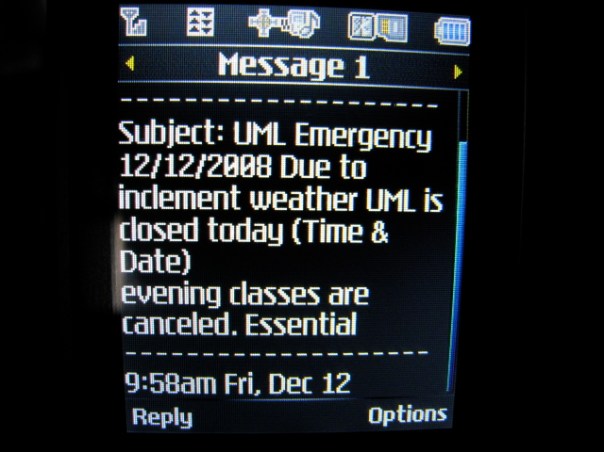
9:58am – UML’s text about campus closing finally reaches me…three hours late!

img_0567

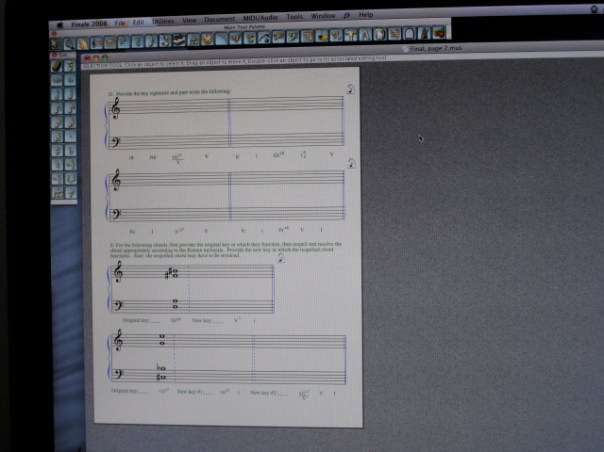
11:43am – Working in Finale, editing a portion of one of my finals I’m giving next week.  Mmm, part-writing.

img_0569

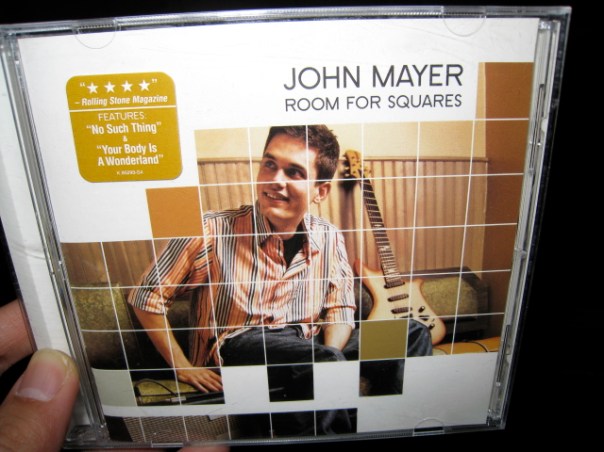
1:47 – While preparing my first-ever batch of homemade chicken noodle soup, I decide to put on a little John Mayer.  I haven’t to listened to this CD in a while: I was reminded of how good it is.

img_0562

2:58pm – My very first pot of chicken noodle soup.  It turned out pretty well.

img_0564

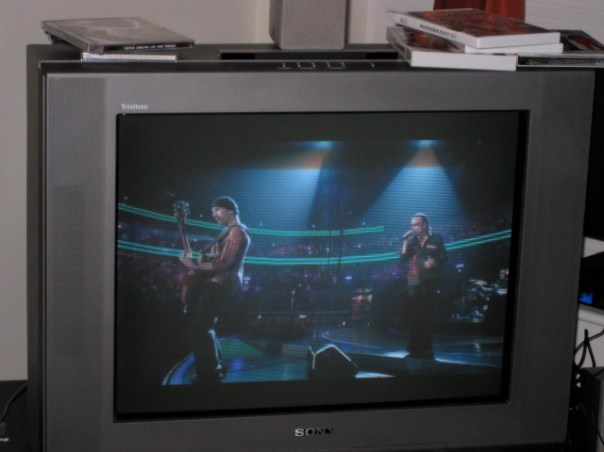
6:36pm – While cleaning up the kitchen and making a breakfast casserole for the weekend, I pop on the DVD of U2’s 2005 Vertigo tour from Chicago.  It was a pretty good show, although I like the Elevation tour DVD from 2001 a little better. 

 img_0566

8:30pm – The breakfast casserole is ready to be put in the oven tomorrow morning.  Thanks for the idea, Mrs. Blessinger (I don’t mean Marty).

img_0572

1:01am – Mike and play a three-game series of NCAA ’09.  He tried a new team, Georgia Tech.  It was an ugly win: I managed to squeak out an overtime victory in game 3.

img_0574

3:12am – After a long chat with Marty and finally taking Oreo out, I crawl into bed and read a few pages of Eclipse before passing out.

Bono Criticism

So, I’m listening to Pandora while packing up my office, preparing for the big move at the end of the month.  I turn on the U2 station that I created (of course), and out of sheer curiosity, I click the band’s biography and peruse the user comments.  I find it interesting that several of the comments totally slammed the band, Bono in particular, for their social work.  Now, I realize that not every one likes U2’s music, and I can live with that.  To each his own.  But some of these users need to get their facts straight.  U2 has not been around for so long just because they’re “the critics [sic] little darlings.”  They’ve won 22 Grammy Awards and have sold almost 150 million albums worldwide, despite getting hammered by those very same critics for releases like Ratttle and Hum and Pop.  More to my point, however: just because you don’t like their music, does that mean you have to bash their character and their charity work?  How is Bono a hypocrite?  How is he “using the children”?  What?  Criticize the music if you must, but I suggest you lay off his charity work.  What have YOU done for societal betterment bromide01, jayroy, and dave3569?  Bono’s got money and star power, and he’s using his cache to try to draw awareness to some pretty horrific situations.

This is a kind of Catch-22, in that Bono’s getting impugned for his charity work because he’s “just a rock star,” yet many of these trigger-happy critics turn right around and attack stars for doing absolutely nothing with their fortunes except horde it for themselves.  Why so bitter, boys and girls?  Jealousy?  Or just plain cynicism?  The way I see it, you can hate the music.  Fine.  You can disagree with his politics.  OK.  But to attack his charity (which comes out of his own pocket, mind you), that’s uncalled for.

Now, I realize that because I wrote my dissertation on U2 this entry isn’t entirely unbiased.  But then again, this blog isn’t about being unbiased; it’s about how I see things.  Disagree with me?  Bring it.