“Silencio” is the second single from U2’s forthcoming 16th studio album, Carnaval De Luz. It was released on 24 September 2026, the day before the band celebrated its 50th anniversary, and same day the band announced the album’s title and release date. Being a superfan and one who specializes in the analysis and interpretation of U2’s music, of course I was excited for the album announcement, but I don’t think I could have predicted just how into this new single I would be.
Let me cut to the chase: I absolutely LOVE this song. Of the 14 new songs released so far this year before “Silencio,” “Resurrection Song” was my clear favorite. Its unabashed defiance of modern cynicism combined with a sense of pure joy made it the most compelling track since “The Little Things That Give You Away,” not to mention it would be a helluva show opener. I’ve probably listened to it a hundred times since April.
And I think I may like “Silencio” even more.
The first thing my wife said to me upon hearing “Silencio” was exactly the same thing that ran through my head the first time I heard it: “It sounds a lot like ‘Vertigo’.” This is a very good thing for me seeing as I love “Vertigo.” And she’s right. Both songs center around a hard-hitting riff that is mixed primarily in the left channel, both have prominent bass lines, and both feature Spanish lyrics.
Wait…How Many Times?
Despite the sonic similarities between the two songs, there’s something about “Silencio” that I simply cannot get enough of. I liked “Vertigo” when it was released 22 (!!) years ago, but I don’t remember being this enthralled with it. Just how into “Silencio” have I been since its release? According to my Spotify listening stats for the week of Monday, 21 September through Sunday, 27 September, I listened to the song 40 times. For a bit of context, the track was only released on Thursday of that week so I listened to “Silencio” 40 times in four days. Add to that another 57 times the following week and that’s 97 times in 11 days…and counting. And that’s just Spotify, mind you, which means those are tallies are from my “non-critical” listening sessions, like when I’m in the car, out on a run, or while in the kitchen making dinner. I use a different app for transcription and analysis work (the elegantly straightforward Sound Studio), so the total has almost certainly surpassed 200 by now if my official “critical” listening sessions are taken into account. (Yeah, OK, so “obsessed” may be an understatement here. Shut up.)
The “Street Of Dreams” single from July is…fine. It makes me smile but it doesn’t exactly light my hair on fire. In all honesty, I thought it was rather tame, especially in light of Bono’s description of the upcoming album last spring as “an unreasonable guitar record.” “Silencio,” on the other hand, fits that description to a tee. It feels like a jolt of adrenaline. The overall sound of the song is exactly what I heard in my head last spring when I read Bono’s comments. Edge’s riff hits like a bucket of cold water; it’s especially powerful because Adam’s delicious opening bass line is still on my palette when the guitarist joins the party. Combined with Larry’s powerful and propulsive drumming, the introduction alone quickens my pulse in a way a U2 song hasn’t in a very long time.
Champing at the Analytical Bit
OK, so the sound of “Silencio” appeals to me. Duh. It’s a U2 song, after all, so that’s not news. This band’s sound has always appealed to me. But what is it about this particular song that has tempted me to play it literally hundreds of times in just a couple of weeks? Of course its punk-like two-and-a-half minute runtime certainly has contributed to the play count but I suspect there’s a more “critical” reason for this obsession. It’s at this point where the music theorist in me wakes up and starts itching for an analytical hit.
The Edge interprets “Silencio” to be about two kinds of quiet: “There’s a beautiful silence, which is, you know, when you’re in that reflective place… But there’s the other form of silence, which is a kind of censorship, [including] self-censorship, which is where things can get very dangerous.” This dichotomy is reflected throughout the song lyrically and formally. Both of the verses are structured in a binary manner, each comprised of two eight-measure stanzas focusing on one kind of silence. The first stanza centers around the “beautiful” silence, the kind that is comfortable (“where a baby doesn’t cry”), exuberant (“exaltation”), and revelatory (“where the mystery unfolds”); the second stanza is about the “dangerous” silence, the kind that is anxiety-riddled (“uneasy feeling”), insecure (“A thief at large”), and oppressive (“shut your fucking mouth”). Even Bono’s Spanish usage reflects the song’s dichotomy: “tranquilo,” “sereno,” “amigo,”—“tranquil,” “serene,” and “friend,” respectively—are used in the first stanza of the verses whereas only the Spanish word “silencio” appears in the second stanzas, here stressing the negative connotation of the word “silence.”
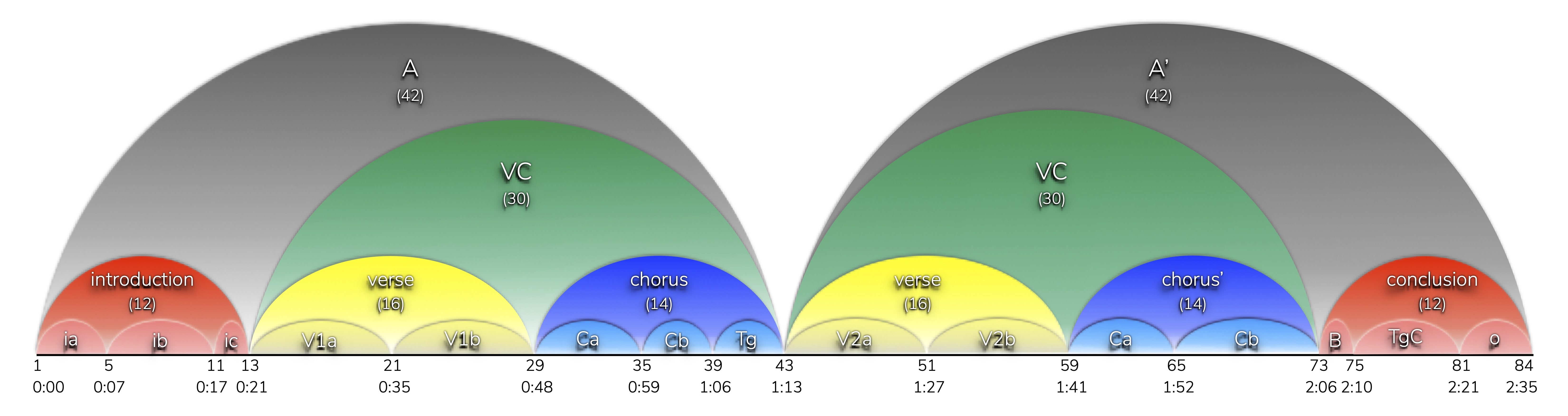
But as much as I like the sound and lyrics of “Silencio,” it’s the form of the song that’s really piques my curiosity. The binary relationship espoused in the lyrics is also reflected at a larger formal scale. Overall, “Silencio” is 84 measures long, which can be divided into two similarly structured 42-measure halves, resulting in a binary A-A’ structure. Of these 42 measures, 30 come from the verse-chorus segment: 16 from the verses (as described above) and 14 from the chorus sections. Although both choruses are the same length, their internal structures differ. Both begin with a six-measure passage that, ironically, features the song’s title shouted several times. The final eight measures of the first chorus (0:48) are split into a four-measure secondary chorus section and a four-measure instrumental tag that serves to conclude the song’s first half. In the second chorus section (1:41), the secondary chorus section is lengthened to eight measures, with the lyrics “Dressed like the devil but tonight you’re the host / Of the Father, Son, and the Holy Ghost” taking the place of the tag.
My big revelation about “Silencio” has to do with the measure count of the sections that begin and end the song. The introductory passage can be segmented into a four-measure bass introduction, a six-measure guitar riff, and a two-measure link, respectively. A similar organization is used at the song’s conclusion but in reverse. Immediately after the second chorus (2:06) is a brief two-measure passage that effectively functions as the song’s bridge, in which Bono whispers in Spanish. This is followed by a six-measure tag-chorus (a section that is musically based on an earlier tag but functions like a chorus), and then a four-measure conclusion that features a Beatles-esque ascending arpeggio build. The 4+6+2 structure from the song’s opening has been reversed at the end of the song to 2+6+4. In other words, the conclusion is a formal palindrome of the introduction, a mirror of the beginning at the very end. Similiar to the two halves of the song sharing the same length and constituent song sections—albeit in a different order—the two kinds of silence are each other’s foils, seemingly fundamentally different on the surface but much more similar to each other upon further reflection. The palindromic relationship is easy to see in the arch map below, with the red sections that bookend the graph representing the introduction and conclusion, respectively.
Continuing the Lineage
All That You Can’t Leave Behind (2000) was hailed as U2’s return to “basics.” After an extensive foray in the world of drum machines and electronics, that meant returning to the core of the sound that helped them earn the title “Biggest Band in the World.” And that meant refocusing on the electric guitar. “Beautiful Day” and “Elevation,” in particular, are songs that not only feature rock’s signature instrument but they are also songs built around iconic riffs. 2004’s How To Dismantle An Atomic Bomb continued that riff-based guitar-centered tradition with “Vertigo.”
When the lead single from No Line On The Horizon dropped in early 2009, I was conflicted. I really wanted to like “Get On Your Boots” more than I did but something about it just didn’t sit right with me. Much like “Street Of Dreams,” it’s a fine song but it didn’t blow me out of the water and I couldn’t figure out why back then. “Get On Your Boots” was meant to be the “Vertigo” of No Line On The Horizon. It’s that album’s lead single and the supposed rocker of the record, but it didn’t quite land. Almost two decades later, I finally figured out why, and “Silencio” helped with that. It’s the production of “Boots” that’s not quite right. The drums are mixed too far back in the sound stage and Edge’s riff doesn’t have the same punch as it does in “Vertigo.” To my ears, “Silencio” rectifies the “missteps” of “Get On Your Boots.” The mix places Edge’s riff at the front, unapologetically in-your-face and full of energy. Likewise, Larry’s drum line is positioned prominently in the mix, which contributes to the song’s intensity (to say nothing of Adam’s awesome bass line). All of this to say that “Silencio” achieves what “Get On Your Boots” could not, which is to be a true successor of of “Beautiful Day” and “Vertigo” and a worthy member of that distinguished sonic lineage. In fact, I’ll go so far as to say that “Silencio” is better than “Vertigo.” That feels like a pretty hot take, and admittedly it’s still a bit strange for me to type, but the more I listen to “Silencio” (and “Vertigo,” for that matter), the more resolute I stand behind that opinion.

